3.a Interpretations and origins of two key terms: ‘metamorphosis’ and ‘transformation’ | 20 min
The terms ‘metamorphosis’ and ‘transformation’ are related but are not synonymous. ‘Metamorphosis’ is associated with animals that are able to transform from one shape into another (even though this was not its original meaning) while ‘transformation’ is a more generic reference to ‘change’, and is commonly used in combination with ‘digital’. To trace the original meaning or the origin of any word (also called a word’s etymology), before the advent of the internet, you had to use a printed dictionary, of which the credibility and authority would be secured by the status of an organisation or person (normally either the publishing house or the editors). Digital technology can help us retrieve various interpretations of their original meanings instantaneously. It can also help with tracing back how these meanings changed over time. Yet, the importance of applying the same source criticism you would use with printed materials applies equally to information resources that one can find on the web.
In this assignment, you are going to look up the etymology (origin) of the words ‘metamorphosis’ and ‘transformation’ in the Online Etymology Dictionary
To check whether you can trust the information on any website, one strategy is to read and apply the criteria for ‘detecting CRAP’ as outlined in this page from Canvas Network’s massive open online course (or MOOC) ‘Understanding Media: Facts, Authority, and What We Believe.’ Read over this page.
Now, look up the etymology of the terms ’metamorphosis’ and ‘transformation’ in the Online Etymology Dictionary and write down the origins of the two terms in your own words in the boxes below. Pay attention to the different parts of the terms, such as any prefixes, verbs, nouns, or suffixes.
| methamorphosis | transformation |
|---|---|
| Etymology | Etymology |
To evaluate the quality of this resource, use the CRAP strategy from above and answer the questions that each letter represents in the box below. Note: You may not be able to find all the information requested - that is OK.
| CRAP | answer |
|---|---|
| C | |
| R | |
| A | |
| P |
3.b Changes in how the terms ‘transformation’ and ‘metamorphosis’ are used in language. | 55 min
The contexts in which particular terms are used is affected by technological, cultural, and economic changes in society. How the use of terms changes over time can be traced with the help of a tool called the Google Books Ngram Viewer. This is a search engine created by Google that charts the frequencies of a term in 18 million books available in the public domain in the English language that were printed between 1500 and 2008. This is done via statistical analysis of yearly counts of words. Although it is not fully representative, it can give a good impression of how the meaning of a term can change over time.
Here is the link to the Google Books Ngram Viewer. You enter terms in the Ngram into the search bar at the top and separate them with a comma. After pressing ‘Search lots of books,’ the Ngram viewer will then show a graph of each term you entered. Have a look at the example below with the terms ‘Albert Einstein,’ ‘Sherlock Holmes,’ and ‘Frankenstein.’ Below the graph, you can also see a set of time periods, arranged chronologically. These are links to a list of books that have been published in this period and are part of the corpus of 18 million books.
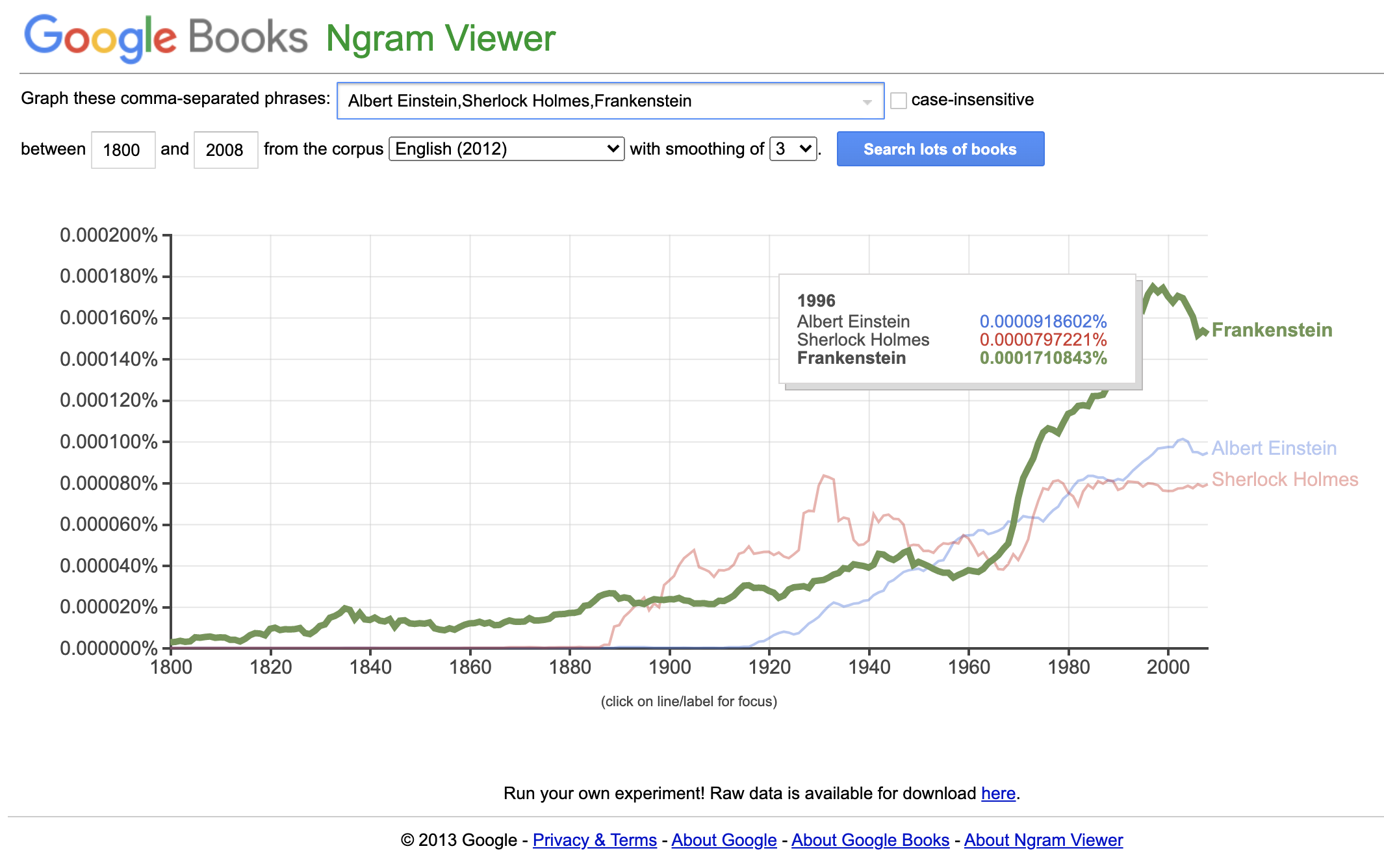
To get a quick overview of how Google Books Ngram Viewer works, read this article from Lifewire
Metamorphosis
-
Now enter the term ‘metamorphosis’ in the Ngram, select the first time period where the term appears below, and glance over the books that appear in that time period.
-
What are the topics of the books with ‘metamorphosis’ in the title? In what kind of section of the library would you find them? How would they be tagged to be traced online?
-
Now go to the last time period, open the link and skim the titles that appear. Is there a change in the kind of context in which the term is used? Is its meaning the same as in the first period?
-
Now open up some links to other time periods. Can you find a title of a book in which the term is used in a different way?
Transformation
-
Now put a comma after ‘metamorphosis’ and add the term ‘transformation’ to your search.
-
What strikes you when you compare the two graphs?
-
Compare the book titles from the first time period to the time period with a peak. Is there a difference in the topics of the books with ‘transformation’ in their title that were published in the early period and with those that were published at the peak of the graph? Identify and list the topics for the early period and for the peak.
Digital Transformation
-
Now delete the terms ‘metamorphosis’ and ‘transformation’ and instead search for the term ‘digital transformation’
-
How would you characterize the topics of the books in the first time period that contain this term in the title?
-
Do you see a difference with the books listed in the last time period?
-
Conduct a search on Google with the term ‘digital transformation’. What strikes you with regard to the contexts in which the term is most present?
While the Good Books Ngram viewer is a useful tool, it is important to note that it also has its drawbacks. Read this article in the American magazine Wired about the pitfalls of using the Google Book Ngram for research.
Evaluation
- How would you judge the results of your searches and assessments now, after taking the criticism of the article in Wired into consideration?
3.c Metamorphosis and Ovid: the classic source | 30 min
Metamorphosis (also known as shapeshifting) has been used as a recurrent theme in mythology, folklore, and speculative fiction since the dawn of time. One of the most influential works inspired by Greek mythology which deals with this topic is Ovid’s epic poem the Metamorphoses. Ovid (known in Latin as Ovidius) was a Roman poet who lived from 43 BC to 17/18 AD and became fairly famous during his lifetime and even more so after his death. His epic poem Metamorphoses consists of over 250 myths centered around the idea of ‘forms that change,’ and recounts the ‘history’ of the world from its creation until the time of Caesar. Metamorphoses has had a significant impact on Western culture ever since its creation including providing inspiration for several of William Shakespeare’s plays. In this assignment, we will explore some of the main themes found in the poem.
-
Listen to the first 10 minutes of this BBC podcast as presenter Melvyn Bragg, author A.S. Byatt, and literary critic A. Catherine Bates discuss the appeal and several themes of Ovid’s poem Metamorphoses and then answer the questions that follow.
-
What is Byatt’s explanation for the appeal of Ovid’s poetry from ancient times to the present? (1:34 - 3:58)
-
During the exchange of opinions on Ovid, in the first eight minutes the experts refer to six mythological forms of transformation, mentioning the names of the deities that are involved. Try to identify them by making use of the hints and the indicated time-stamps in the table.
| Hint | Who is involved and what is at stake? |
|---|---|
| A human being is turned into an animal (2.45) | |
| A deity is turned into a bush (4.48) | |
| A woman is turned into a fisherman (5.09) | |
| From girl to man (6.00) | |
| Women turn into trees (6.30) | |
| Women turn into a stone (7.11) |
This is a link to a translated version of Ovid’s work by Anthony. S. Kline, published online in open access by the University of Virginia and made searchable. In the index you can look up the names of the mythological protagonists in Ovid’s Metamorphosis. Use the resource to trace the stories in the poem that are connected to the names you have identified in the podcast. Put the link in the field with a short description of what the context is. (75 words max.)
3.d Metamorphosis depicted in paintings | 40 min
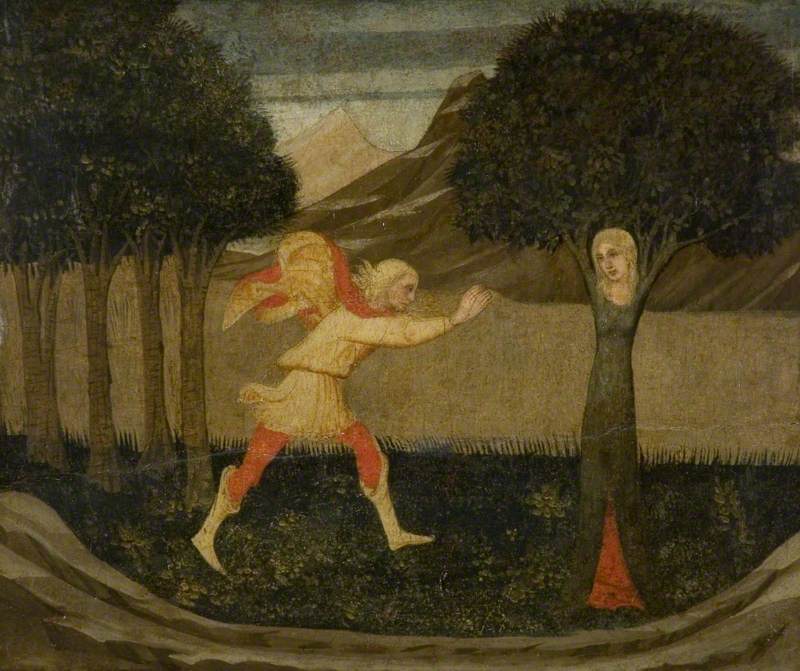
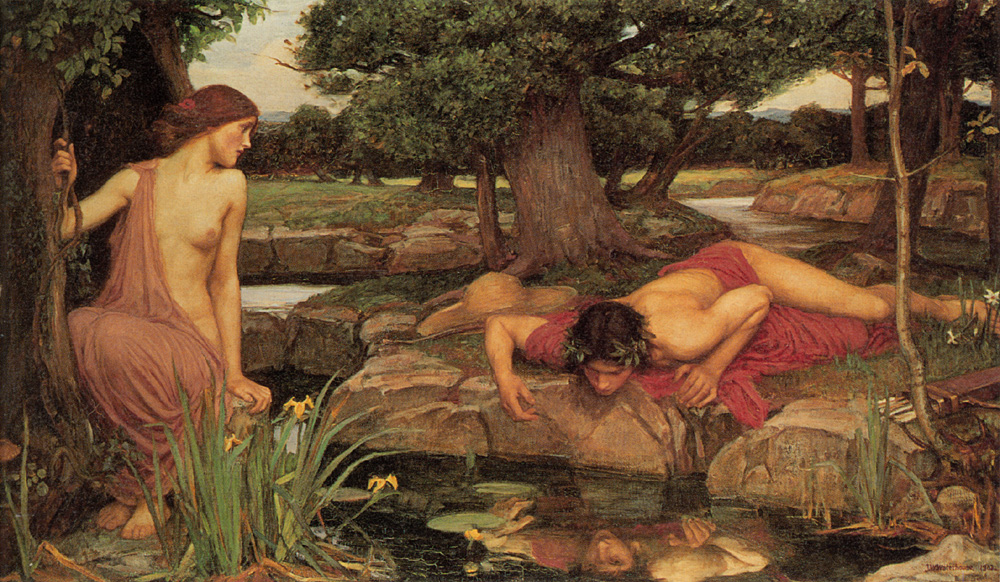
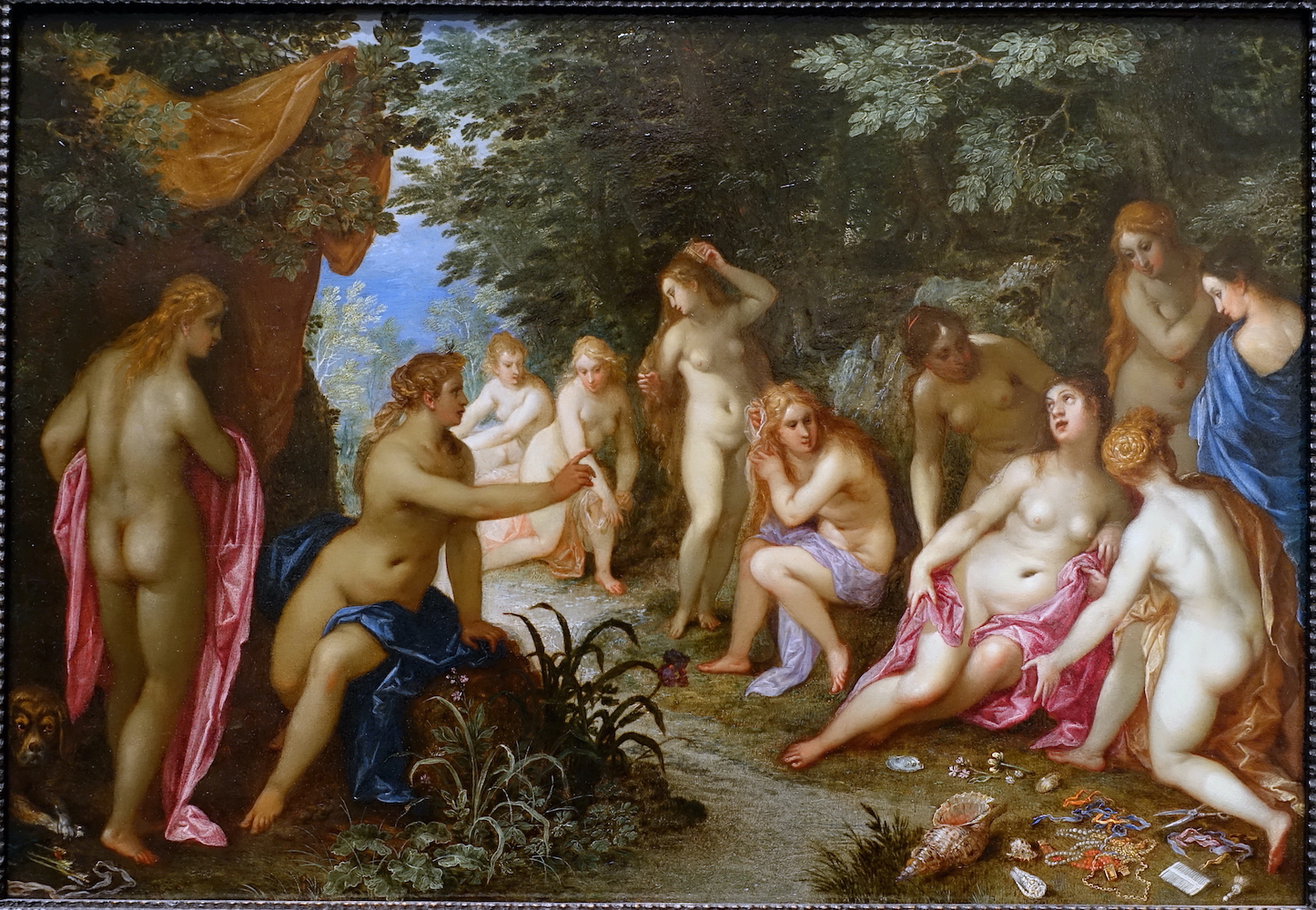
It was the Roman poet Ovid’s fascination for the world being in a constant state of flux that led to the creation of his epic poem Metamorphosis. The fact that this fascination is everlasting is illustrated by the massive impact of his poem, especially on Western culture. Renaissance and Baroque artists frequently depicted mythological scenes and characters from his poem while famous authors such as Shakespeare and Chaucer drew on his work. Ovid would probably have been thrilled to learn that nowadays the structure of his work can be analyzed with the help of digital tools. The recurrent use of the term ‘transformation’ when referring to the impact of digital technology on today’s society echoes Ovid’s enchantment with change. In this assignment, you will identify themes from the Metamorphoses that are depicted in paintings which, thanks to digital technology, we now have instantaneous access to.
As mentioned, Ovid’s Metamorphoses has had a significant impact on Western culture, especially within the art world. While themes and scenes from the Metamorphoses can be found in literally hundreds of paintings all over the globe, here we will examine several which are the most well-known.
-
Contextualise two of the paintings in the table below by researching the title of the work, the painter, and the year(s) it was painted in and put the information (as well as a link to the image) in the second column. You can use a reverse image search service such as Google Search by Image or Tineye, or you can try to describe the image using the usual keyword search on a search engine of your choice. To use reverse image search, make a screenshot of the images you have chosen, and upload them in the search box.
-
Next, describe in your own words the myth being depicted in the painting. Then, find the corresponding passage about the mythological figures that is depicted in the painting in this online version of the Metamorphoses hosted by the University of Virginia in the USA and paste it in the table with its corresponding link, in size 8 font. Take into account that the spelling of the names may vary and that the online version of Ovid’s poem contains an alphabetical index of all the names used.
-
For the last column, conduct web research to find out whether the mythological figure(s) depicted in the painting and described in Ovid’s poem have inspired any contemporary artists. If so, document the name of the author, the work of art, the context in which it was made, and a link to the work or an article about it.


| Question | Answer |
|---|---|
| Name, author, date | |
| Which is the Myth depicted (with description of characters)? | |
| Link to corresponding passage from Ovid’s Metamorphoses? | |
| Name contemporary artist and work of art? |
| Question | Answer |
|---|---|
| picture | 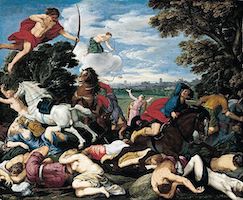 |
| Name, author, date | The Death of Niobe’s Children, Johann König (First half of 17th century) |
| Which is the Myth depicted (with description of characters)? | The twin children of Latona, Phoebus (Apollo) and Phoebe (Artemis), kill all 14 of Niobe’s children in punishment for her refusal to worship Latona. From: Bk VI:204-266 The gods’ vengeance: Niobe’s sons are killed |
| Link to corresponding passage from Ovid’s Metamorphoses? | “There was a broad, open plain near the walls, flattened by the constant passage of horses, where many wheels and hard hooves had levelled the turf beneath them. There, a number of Amphion’s seven sons mounted on their strong horses, and sitting firmly on their backs, bright with Tyrian purple, guided them using reins heavy with gold. While Ismenus, one of these, who had been the first of his mother’s burdens, was wheeling his horse’s path around in an unerring circle, and hauling at the foaming bit, he cried out ‘Oh, I am wounded!’ and revealed an arrow fixed in his chest, and loosing the reins from his dying hands, slipped gradually, sideways, over his mount’s right shoulder. |
| Next Sipylus, hearing the sound of a quiver in the empty air, let out the reins, just as a shipmaster sensing a storm runs for it when he sees the cloud, and claps on all sail, so that not even the slightest breeze is lost. Still giving full rein, he was overtaken, by the arrow none can avoid, and the shaft stuck quivering in his neck, and the naked tip protruded from his throat. Leaning forward, as he was, he rolled down over the mane and the galloping hooves | |
| Name contemporary artist and work of art? | https://www.widewalls.ch/banksy-art-from-gaza-and-then-more-banksy/ Banksy in Gaza – image of Niobe (courtesy of banksy.co.uk) |