2.a General policies and guidelines | 30 mins
To explore the opportunities that Wikipedia offers for historical research, we should first understand how Wikipedia works. Even though Wikipedia promotes the idea that “anyone can edit nearly any page and improve articles immediately”, it enforces a system of rules, policies and guidelines that govern knowledge production and users’ engagement with Wikipedia content. Wikipedia includes subjects ranging from mathematics and biology to sports, culture and the arts. Although all Wikipedia guidelines and policies are applicable for all subjects, there are also particular rules for each subject. This assignment encourages learners to explore the broader system of the Wikipedia community, while at the same time focusing on history as a Wikipedia subject category.
The following Wikipedia pages contain specific information on Wikipedia’s policies, guidelines and rules, which determine how knowledge is produced on Wikipedia.
- Start by familiarising yourself with the three core principles that sum up Wikipedia. These will give you a basic understanding of the main principles that guide editing on Wikipedia.
- For a more in-depth view, you can then check out the “five pillars” – the more detailed principles that form the basis of Wikipedia’s editorial policy.
- If you wish to go further, you can also read the statement of principles from Wikipedia founder Jimbo Wales – however, this reading is not necessary for the exercise.
Now discuss and try to answer the following questions:
- What are the most important principles and policies of Wikipedia?
- Which policies and guidelines encourage Wikipedia users to engage with its content?
- Why is it that this system of policies and guidelines does not prevent users from editing content but motivates them to create or update more and more Wikipedia articles?
Just like historians, Wikipedians use sources to create and update Wikipedia articles. Wikipedia provides a comprehensive summary of what sources Wikipedians can use. Please read the introduction and overview sections of the article and try to answer the following question:
- What should be the characteristics of the sources that Wikipedians can use?
2.b Talk pages and page history | 30 to 40 mins
As well as the policies and guidelines that underpin knowledge production on Wikipedia, every Wikipedia article page has two tabs, the “talk page” or discussion page and the “view history” tab (fig. 1). You can access these pages from the main menu that you see under the title of the article.
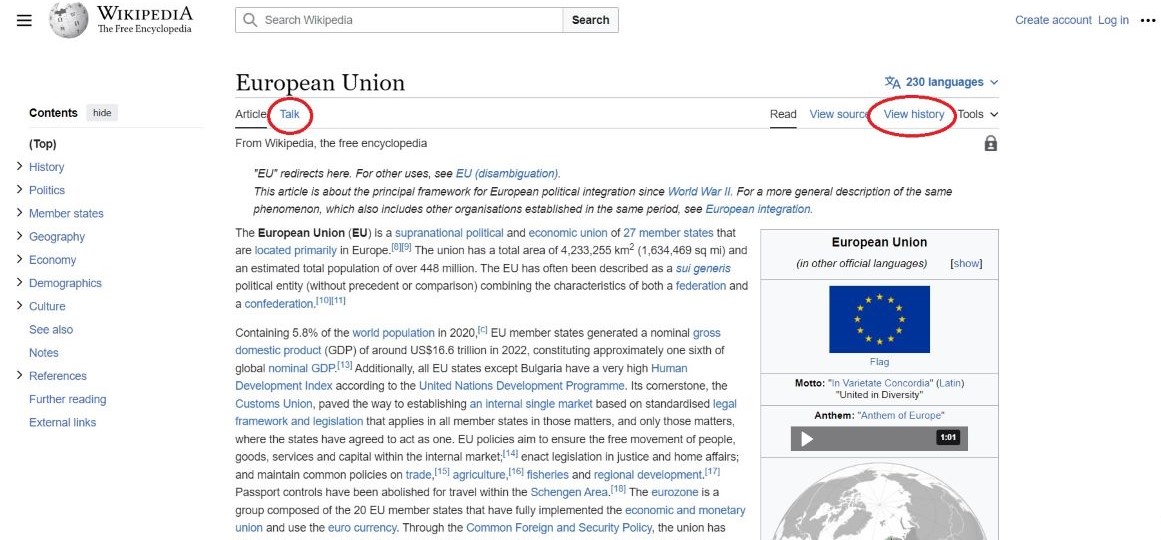
On the “talk page”, users can find all the archived discussions about edits made to the given entry over time. This space also shows all the discussions and debates between Wikipedia users about the entry. Users often challenge information in the Wikipedia entry, expressing their disagreement and making suggestions for the page. Other users then reply, and the “talk” page becomes a discussion page. The “view history” page includes logs of all the changes (without the discussion) and copies of older versions of the articles. This kind of information can help historians apply the basic principles of traditional source criticism to identify how a source has been created and by whom.
In the two links below, you will find more information on “talk pages” and “view history”. Please read the content of the two articles:
“Talk pages” (estimated reading time: 10 minutes) – alternatively, you can watch a two-minute video: “Wikipedia basics – Talk pages” provided on the page.
“View history” (estimated reading time: 12 minutes) – alternatively, you can watch a nine-minute video: “Using the view history tab on Wikipedia” provided on the page.
Now try to answer the following questions:
- How can the “talk page” and “view history” sections of Wikipedia articles be useful for historians?
- What historical questions can the data from “talk pages” and “view history” answer?
If you choose to watch the videos to answer the questions, this assignment should take 30 minutes. If you choose to read the articles to answer the questions, this assignment should take 45 minutes.
2.c History on Wikipedia | 15 mins
As Wikipedia covers multiple subjects, it has created separate portals for each subject it covers. In these portals, there are definitions of the subject and further information about the different subfields and categories of the subject. As well as the general guidelines and policies, the Wikipedia community has also produced more specific instructions about the coverage of each subject. As history is one of Wikipedia’s subjects, it has its own portal and is subject to specific writing rules. For example, Wikipedia specifies the types of sources that Wikipedians are allowed to use to cover historical topics.
To learn more about the subject of history on Wikipedia, please go to the home page of the history portal and explore the following aspects:
- the definition of history the page provides
- the different page sections
Now try to answer the following questions:
- How does Wikipedia seem to perceive history?
- In what ways is this perception similar to or different from definitions provided by academic historians?
If necessary, see the reading/viewing suggestions section below for resources with academic definitions of history.
2.d Sources of history according to Wikipedia | 40 mins
To conduct historical research, historians use sources from the past. They use primary sources, which include materials created during a historical period, e.g. written archives, audiovisual archives, oral interviews, objects, etc., and reveal information about the society, culture, economy, politics and technology of the past. Historians also use secondary sources, e.g. books and articles, which place primary sources in the broader historical context of the period. By combining primary and secondary sources, historians write and tell a story about the past.
Please read this Wikipedia page explaining the sources that editors are allowed to use when they write about history on Wikipedia.
Then try to answer the following questions:
- What sources can Wikipedia editors use to create or edit pages related to history?
- Are the sources that Wikipedia recommends different from the sources that academic historians use?
Reading/viewing suggestions
On Wikipedia infrastructure
Apostolopoulos, Petros. 2024. Producing and Debating History. Historical Knowledge on Wikipedia. Berlin, Boston: De Gruyter Oldenbourg. Available open access at https://doi.org/10.1515/9783111069586 (Chapter 1).
Reagle, Joseph. Good Faith Collaboration: The Culture of Wikipedia. Massachusetts: The MIT Press, 2010. Available at: https://direct.mit.edu/books/book/5341/Good-Faith-CollaborationThe-Culture-of-Wikipedia (Chapters 3, 4, 6 & Conclusion)
On definitions of history by academic historians, in case you need help with sub-assignment 2.c
Then & Now. “What is History? E.H. Carr.” YouTube video. 09:54 minutes. 10 October 2018. https://youtu.be/gkdzu8X84fo
“Zachary Schrag on History.” YouTube video. 40:44 minutes. 27 April 2021. Extract from 1:40 to 7:23: “History as the study of people” https://www.youtube.com/watch?v=YVDkShUW6oM&t=100s
On the notion of sources in history, in case you need help with sub-assignment 2.d
“Primary and secondary sources explained.” History Skills https://www.historyskills.com/. https://www.historyskills.com/source-criticism/analysis/source-kind-and-type/